
E&O Laboratories Ltd have successfully grown their Culture Media business over the last 30 years to become a leading manufacturer
servicing Microbiology Laboratories , Location in Scotland. Their comprehensive media range is continually expanding into specialised industry sectors as well as aiding the rapid diagnosis of the newest antibiotic resistant bacteria strains.
INDUSTRY SECTORS:
• Clinical, Veterinary & Aquaculture
• Food, Water & Environmental
• Pharmaceutical, Industrial & Cosmetics
• Academia & Research
PRODUCT CATEGORIES:
• Ready-to-use Culture Media – Bottled, Bagged and Plated
• Dehydrated Culture Media & Raw Materials
• Antibiotic Supplements & Reagents
• Fresh Donor Horse & Sheep Blood – Frozen Sterile Filtered Serum
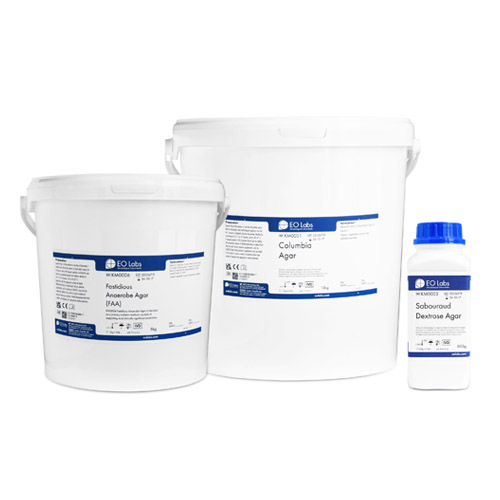
Dehydrated Culture Media products are formulated to supply the required nutrients to allow for the growth of microorganisms. Used in combination with a variety of selective agents and incubation conditions a wide range of specific organisms can be isolated. With careful raw material selection of the various media components E&O can ensure a consistent level of quality and performance. For each formulation the necessary ingredients are accurately weighed, combined and blended together to produce a homogenous powdered product.
Tryptone Soya Broth TSB
- Product Details
- APPLICATIONS
- SPECIFICATIONS
- CODE
- DOCUMENTS
A general purpose and nutritious medium for the non-selective enrichment of non-fastidious and some fastidious organisms. Tryptone and soy peptone are the nitrogen and vitamin source in the medium. Glucose is the carbon energy source that facilitates organism growth and sodium chloride maintains osmotic balance. Di-potassium hydrogen phosphate is a buffering agent to prevent auto-sterilisation due to acid production during the growth of some organisms.
Tryptone Soya Broth is also commonly referred to as Soybean-Casein Digest Medium or Tryptic Soya Broth and is abbreviated as TSB. TSB conforms to the Harmonized United States Pharmacopoeia (USP), European Pharmacopoeia (EU), and Japanese Pharmacopoeia (JP).
